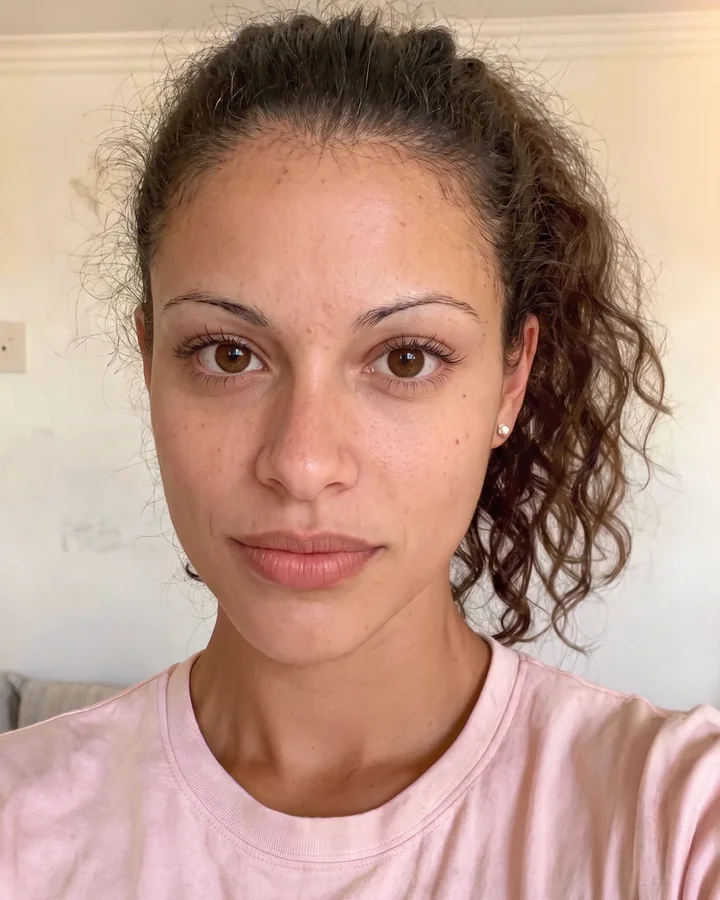
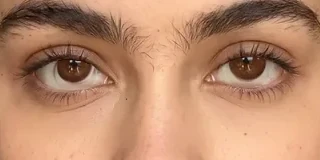
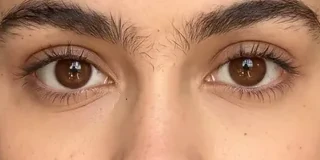
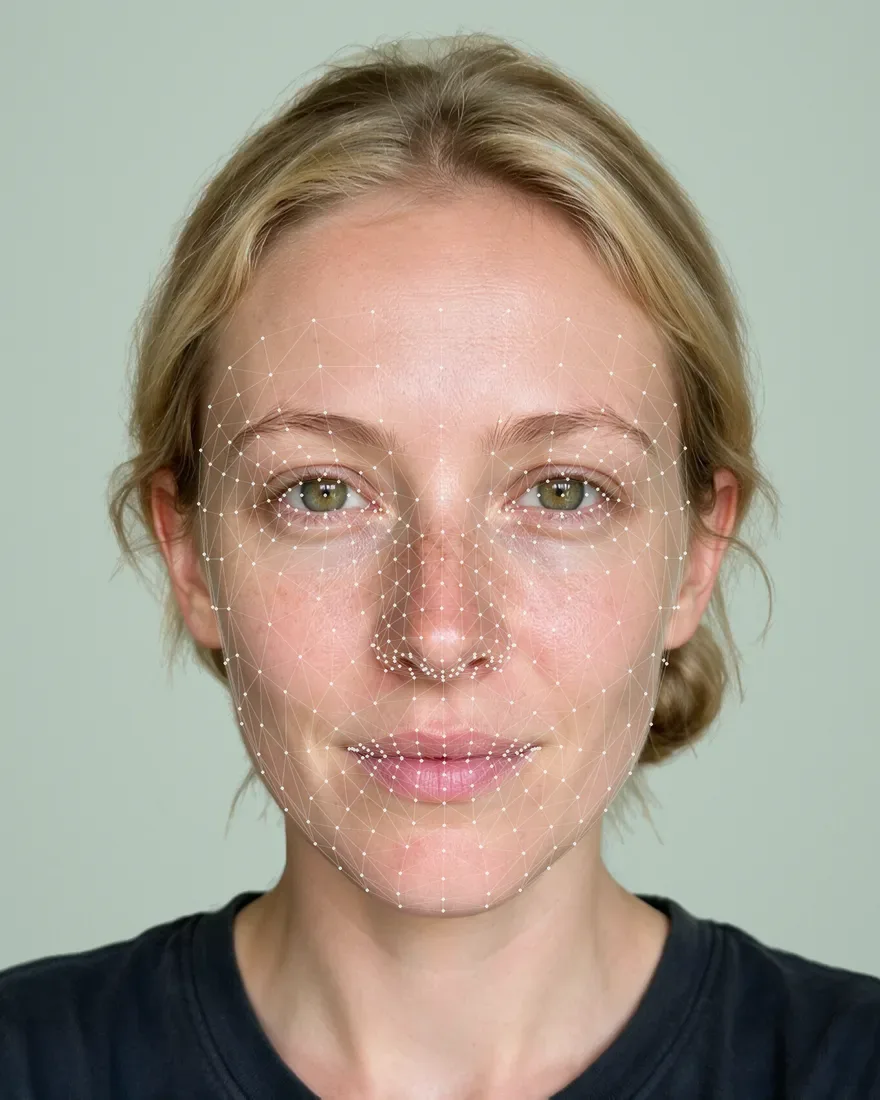
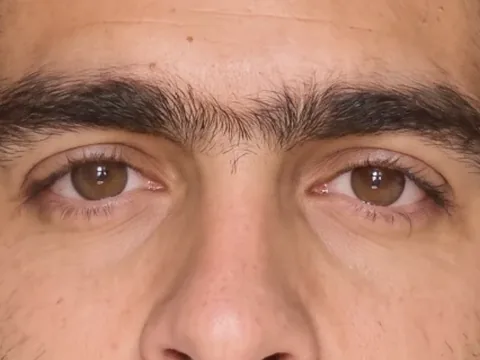
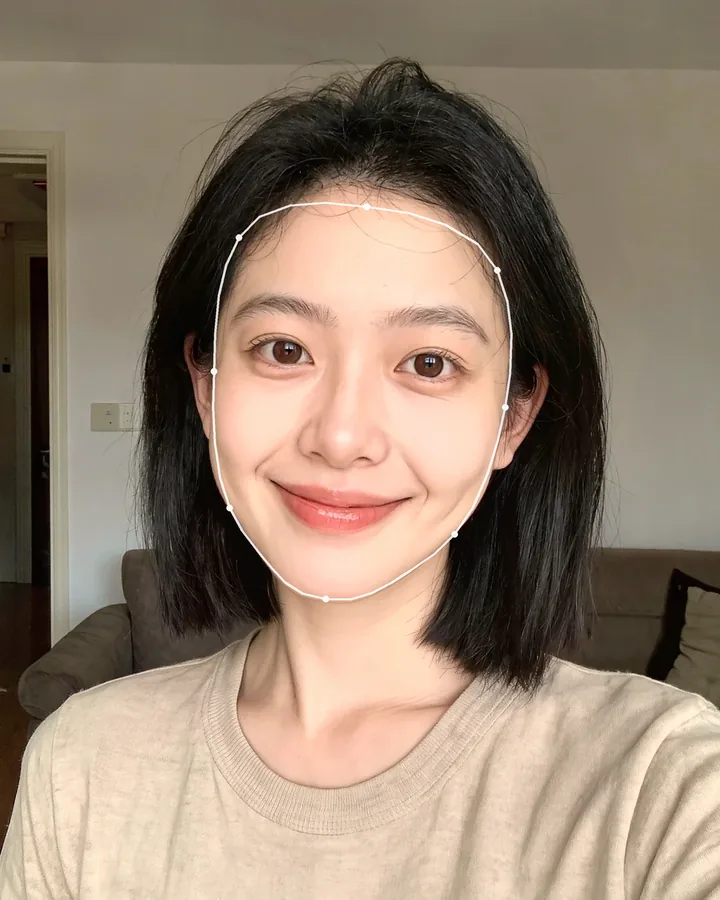
Each iris is drawn as a circle through its two edge dots. The gap is the distance from the bottom of that circle to the lower-lid dot, as a share of the iris height. When you say the phone was above your eyes, the test allows a thin strip of white for that angle. Below: what each pattern means, how camera height adds white, and our sources.
What sanpaku means
What does "Sanpaku" mean? In Japanese, sanpaku literally means "three whites." On most people, you only see the white of the eye (the sclera) on two sides: left and right of the colored iris. If a strip of white also shows below the iris when looking straight ahead, it is called Yin Sanpaku. If white shows above the iris, it is called Yang Sanpaku (superior scleral show at upper lid).
What counts? This test calls it sanpaku when a visible strip of white shows below the iris with the camera at eye level. A hairline gap, or a lid that covers the iris edge, reads as no sanpaku.
How the test reads the gap
These are this test's own cut-offs, not clinical definitions. The gap is measured as a share of the iris height, so it works at any photo size. The bands are wide on purpose, so a dot a pixel or two off does not change the answer.
| Where the lower-lid dot sits | What it says |
|---|
| More than 5% of the iris height above the bottom of the iris | Lid covers the bottom of the iris |
| Within 5% above to 12% below the bottom of the iris | Lid meets the bottom of the iris |
| More than 12% of the iris height below the bottom of the iris | A strip of white shows below |
| White shows, the phone was above your eyes, and the strip is within this test's allowance for that angle (10% of the iris height) | White shows, likely from the camera angle |
| White shows with the phone at eye level or below, or more white than this test's allowance for a high phone | White shows, and it's your lids |
Why the test gives no millimetres
The only ruler in a selfie is the iris itself. The clear part of the adult eye is about 11.71 ± 0.42 mm across (Rüfer et al. 2005), so the test could turn pixels into millimetres, but the answer would look far more exact than it is. The 12% band is about 1.4 mm on an average iris, the 5% band about 0.6 mm, and this test's allowance for a high phone about 1.2 mm. The example photos here show each iris about 30 to 36 px wide, so one pixel is already about a third of a millimetre. Zoom into one eye to place each dot; the bands are wider than a pixel or two of error.
| Iris width in the photo | One pixel is about | The 12% band is about |
|---|
| 20 px | 0.59 mm | 2.4 px |
| 30 px | 0.39 mm | 3.6 px |
| 40 px | 0.29 mm | 4.8 px |
| 60 px | 0.20 mm | 7.2 px |
| 100 px | 0.12 mm | 12 px |
So the test reads the white in three wide bands and says what it sees in words.
Three common looks
Your colored iris is a circle sitting inside the almond-shaped window of your eyelids. On most faces the upper eyelid covers the top edge of the iris, and the lower eyelid rests along its bottom edge. These are the three looks this test tells apart:
What counts as normal vs. sanpaku eyes?
Eye doctors and facial studies measure how tall the eye opens and where each lid sits against the iris (van den Bosch et al. 1999; Rhee et al. 2012). Here is how the common patterns compare, in plain words:
| Pattern |
White below the iris |
White above the iris |
What it looks like |
| Lid over the iris edge · No lower white | None: the lower lid overlaps the bottom of the iris | None | The lower lid sits snug along the bottom of the iris. |
| Lid at the iris edge | None, or a hairline | None | No white strip at talking distance, though a thin strip can appear when you look up at a high selfie camera. |
| Selfie-angle white · From the camera, not the lid | A strip in the photo, none at eye level | None | A phone held above eye level makes your eyes roll up to the lens while the lower lid stays put, which shows white below the iris. |
| Mild lower sanpaku | A thin crescent, even at eye level | None | A thin crescent of white shows under the iris even when looking straight into a mirror, even with the phone at eye level. |
| Clear lower sanpaku · Inferior scleral show | A clear band at eye level | None | A clear white band under the iris, from a rounder eye opening, a lower outer eye corner or how the cheek sits below the eye. |
| Upper sanpaku (yang) · Superior scleral show | None, or a hairline | A strip above the iris | White shows above the iris. It usually happens when someone widens their eyes for a photo. If it shows at rest, check with an optometrist. |
Why a high phone creates sanpaku eyes in selfies
Many people hold the phone above eye level for a selfie and tip the chin down so the jawline looks sharper. To look at the lens, the eyes roll up while the lower lids stay where they are, so white shows below the iris. A phone held close also changes how the face looks (Ward et al. 2018), and people judge a face differently when the photo is taken from close up (Bryan et al. 2012).
| Where the camera is |
What happens to your eyes |
What to do |
| At eye level, a few steps away (or a mirror) | No added white. This is the true reading. | Stand a few steps back from a mirror, or have someone take the photo at your eye height. |
| A little above eye level | Your eyes roll up a little to find the lens, and a thin strip of white can appear below the iris. | Lower the phone until the lens is level with your pupils. |
| High, with the chin tucked | The eyes roll up further while the lower lids stay put, so more white shows. | Hold the phone at eye height with your chin level, or ask someone else to take the photo. |
Photos and makeup around the eyes
If you want the white below your iris to show less in photos, or want to play it up, two everyday changes help:
Put the camera at eye level
Whenever you take a photo or sit on a video call, put the lens level with your pupils, or a touch lower, and keep your chin level. Looking straight at the lens, or slightly down at it, closes the strip of white a high camera adds.
Lashes and the lower waterline
To show less white: darker lashes on the lower lid. To play it up: a light pencil on the lower waterline. Both are a matter of taste.
Sources
-
van den Bosch WA, Leenders I, Mulder P (1999). Topographic anatomy of the eyelids, and the effects of sex and age. British Journal of Ophthalmology, 83(3), 347–352.
DOI: 10.1136/bjo.83.3.347
-
Rhee SC, Woo KS, Kwon B (2012). Biometric study of eyelid shape and dimensions of different races with references to beauty. Aesthetic Plastic Surgery, 36(5), 1236–1245.
DOI: 10.1007/s00266-012-9937-7
-
Price KM, Gupta PK, Woodward JA, Stinnett SS, Murchison AP (2009). Eyebrow and eyelid dimensions: an anthropometric analysis of African Americans and Caucasians. Plastic and Reconstructive Surgery, 124(2), 615–623.
DOI: 10.1097/PRS.0b013e3181addc98
-
Ward B, Ward M, Fried O, Paskhover B (2018). Nasal Distortion in Short-Distance Photographs: The Selfie Effect. JAMA Facial Plastic Surgery, 20(4), 333–335.
DOI: 10.1001/jamafacial.2018.0009
-
Bryan R, Perona P, Adolphs R (2012). Perspective distortion from interpersonal distance is an implicit visual cue for social judgments of faces. PLoS ONE, 7(9), e45301.
DOI: 10.1371/journal.pone.0045301
-
Rüfer F, Schröder A, Erb C (2005). White-to-white corneal diameter: normal values in healthy humans obtained with the Orbscan II topography system. Cornea, 24(3), 259–261.