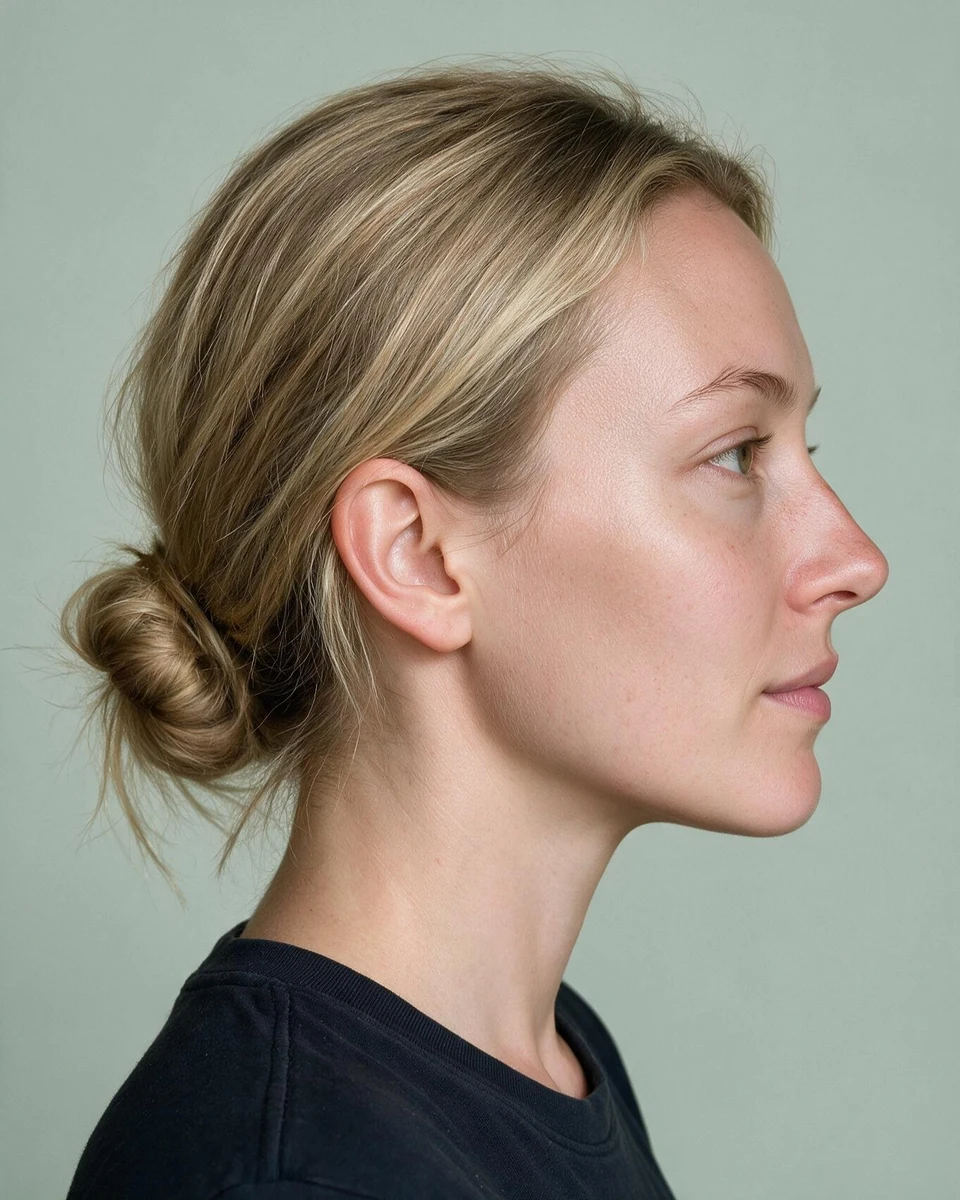
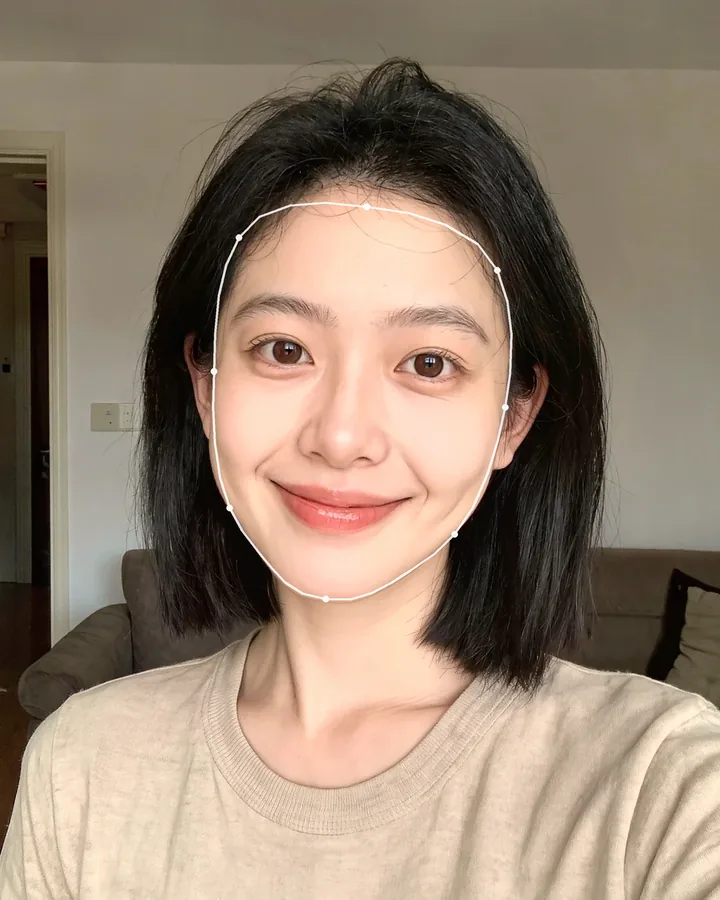
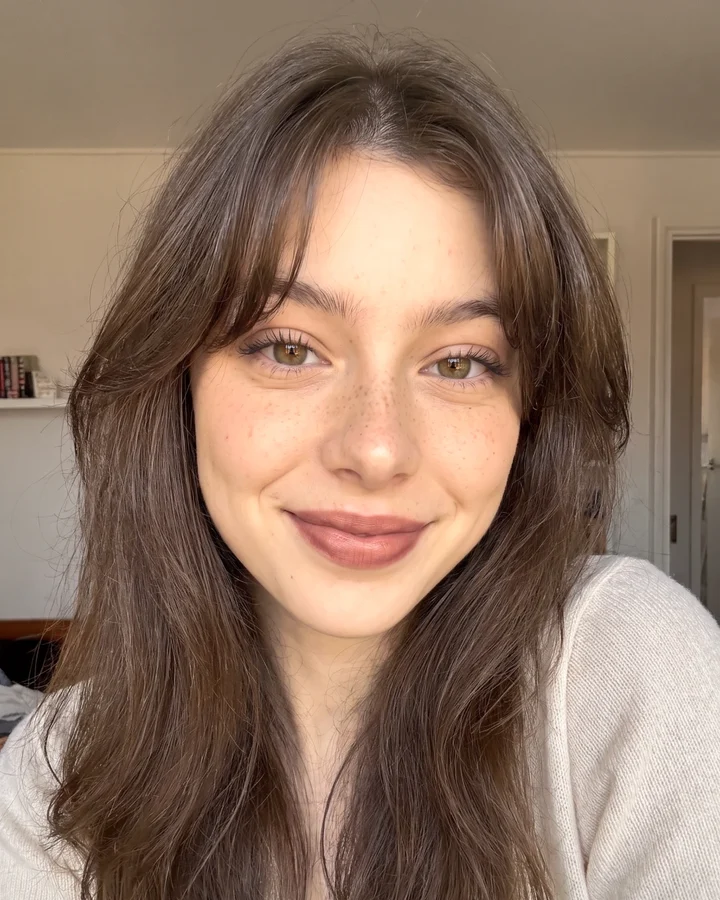
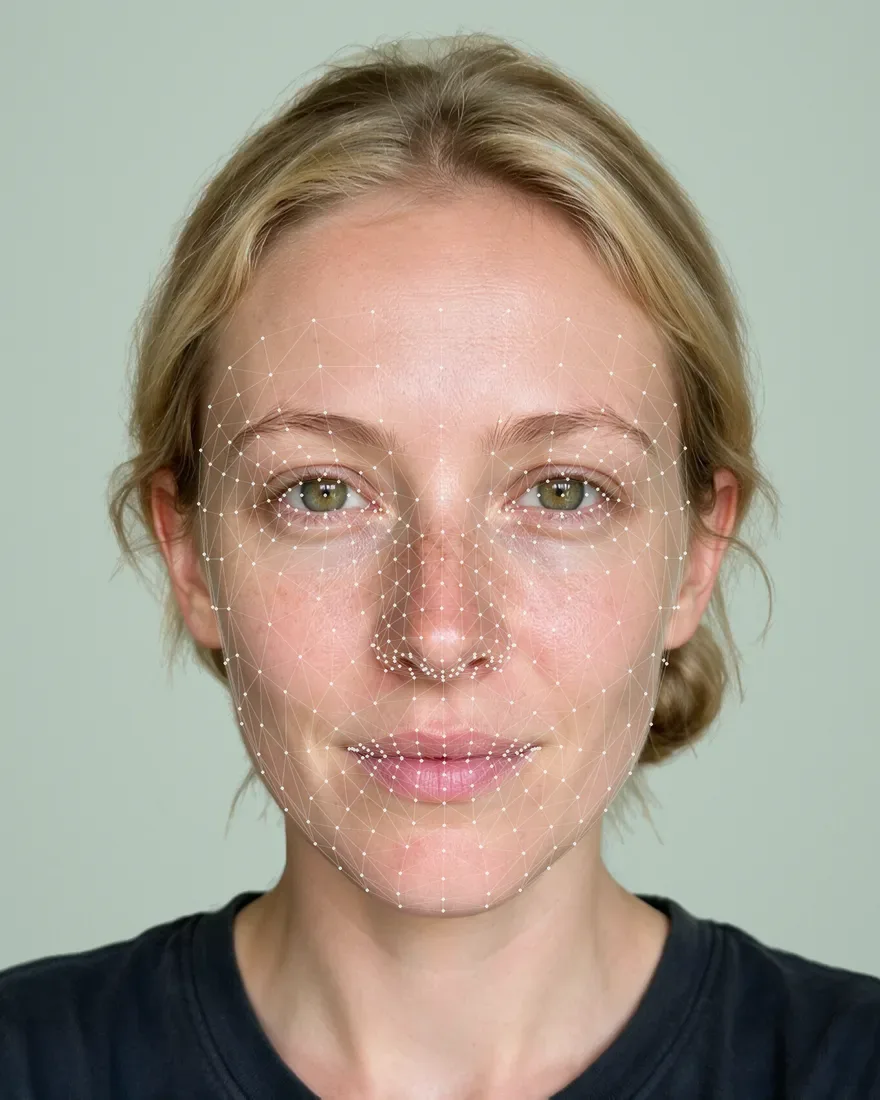
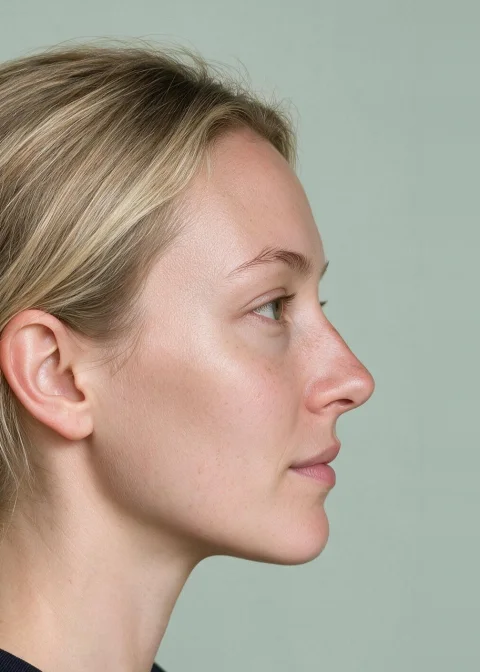
We draw a line from your nose tip to your chin tip and measure how far each lip sits from it, as a share of that line's length. We compare that with Ricketts' targets (upper lip about 4 mm behind, lower about 2 mm, on an average face). Below: the dots, the targets and our sources.
How your nose, lips, and chin line up on a side photo
When you look in the mirror straight on, you can see how wide your smile or cheekbones are, but you cannot see how far forward your nose, lips, and chin project. The E-line needs four points along the centre of your profile:
What the calculator compares your lips with
Robert Ricketts (1968) set two targets for adults: the upper lip about 4 mm behind the line from nose tip to chin, and the lower lip about 2 mm behind it. The standard texts quote about 2 mm either side of the lower-lip target, and the targets came from European-ancestry faces.
Many East Asian and African faces naturally have fuller lips, so lips that touch or pass the line are common and normal there. If that is you, read a Close to or past the line result as normal for your face.
A phone photo has no ruler in it, so the calculator never reads millimetres off your photo. It measures each lip's distance from the line as a share of the line's own length, and turns Ricketts' targets into the same shares for a line of average length (about 65 mm). With a window of about 2 mm either side (for the upper lip we use the same window as the lower lip), an upper lip reads just behind the line from about 2 mm to 6 mm behind it on an average face, and a lower lip from about 0.5 mm to 4 mm behind it. On a nose-to-chin line of that length, the shares work out to the millimetres below.
| Reading |
Target |
Where it comes from |
What the calculator says |
| Upper lip |
about 4 mm behind the line |
Ricketts (1968); the window is ours |
From about 2 mm to 6 mm behind the line: just behind the line. Further back: further behind. Further forward: close to, on or past the line. The 2 mm window is the lower lip's, used for the upper lip too. |
| Lower lip |
about 2 mm behind the line, give or take 2 mm |
Ricketts (1968) |
From about 0.5 mm to 4 mm behind the line: just behind the line. Further back: further behind. Closer: on or past the line. |
| On the line |
within about 0.5 mm of it |
Our rule |
A lip this close reads On the line; further in front reads Past the line. |
| At the edge |
up to about 0.75 mm past the edge of the window |
Our rule |
Still reads Just behind the line, and the result names the answer that lip is close to. A dot on a phone photo can't be placed closer than that, so a lip this close to the edge never gets a firmer answer. |
| One lip off |
the two lips read differently |
Our rule |
The result names the lip, for example Upper lip further behind the line. |
| Both lips |
one off each way |
Our rule |
One lip further behind and the other close to or past the line reads One lip back, one forward: check both lip dots first. |
Why close-up phone selfies move the E-line
Ward et al. (2018) showed that a photo taken from about 30 cm (12 in) makes the nose look wider than one taken from about 1.5 m (5 ft). Bryan et al. (2012) found that people read faces differently when the photo is taken from close up. On a side photo, the nose sits closest to the lens, so it looks bigger and the nose-to-chin line moves.
Holding the phone in one hand and looking out of the corner of your eye to tap the shutter also turns your head a little toward the camera. Even a small turn moves the nose tip and hides part of the chin. Prop the phone about 1.5 m away, turn your whole body sideways and use a timer.
How styling changes where your lips seem to sit
Braces and surgery change teeth and bone. A chin beard changes where the chin end of the line falls, and lip colour changes how full your lips look from the side, with no change to the bone:
Chin beard
If you'd like your chin to look further forward, a beard kept a little longer on the front of the chin, with the hair under the jaw trimmed short, brings the chin end of the line forward. A long front does the opposite for lips that already sit further behind the line: it pushes the chin end out, so they sit even further behind it.
Lip colour
If you'd like your lips to look fuller from the side, gloss and lighter shades help. Matte and deeper shades make them look less full.
Sources
-
Ricketts RM (1968). Esthetics, environment, and the law of lip relation. American Journal of Orthodontics, 54(4), 272–289.
DOI: 10.1016/S0002-9416(68)90278-9
-
Holdaway RA (1983). A soft-tissue cephalometric analysis and its use in orthodontic treatment planning. Part I. American Journal of Orthodontics, 84(1), 1–28.
DOI: 10.1016/0002-9416(83)90144-6
-
Arnett GW, Jelic JS, Kim J, et al. (1999). Soft tissue cephalometric analysis: diagnosis and treatment planning of dentofacial deformity. American Journal of Orthodontics and Dentofacial Orthopedics, 116(3), 239–253.
DOI: 10.1016/S0889-5406(99)70234-9
-
Powell N, Humphreys B (1984). Proportions of the Aesthetic Face. Thieme Medical Publishers (New York).
-
Ward B, Ward M, Fried O, Paskhover B (2018). Nasal Distortion in Short-Distance Photographs: The Selfie Effect. JAMA Facial Plastic Surgery, 20(4), 333–335.
DOI: 10.1001/jamafacial.2018.0009
-
Bryan R, Perona P, Adolphs R (2012). Perspective distortion from interpersonal distance is an implicit visual cue for social judgments of faces. PLoS ONE, 7(9), e45301.
DOI: 10.1371/journal.pone.0045301